Par Jean-Michel Salaun le vendredi 10 février 2012, 06:14
J'ai oublié de signaler que le séminaire sur l'Architecture de l'information, cette année plus orienté vers les réseaux sociaux, avait repris. Nous avons eu la semaine dernière une séance sur Mouvement sociaux et réseaux sociaux avec A. Casilli et par visioconférence depuis Tunis nos collègues de l'ISD, Raja Fenniche, Mohamed Ben Romdhane et Aida Chebbi.
Vendredi prochain 17 février, le thème est Réseaux Sociaux et Visualisation.
Visualisation interactive de réseaux sociaux : dernières avancées et défis,
Jean-Daniel Fekete, directeur de recherche à l’INRIA, responsable de l’équipe-projet AVIZ.
Depuis dix ans, des progrès significatifs ont été réalisés dans le domaine de la visualisation interactive des réseaux sociaux. Ces progrès permettent d’explorer et de naviguer dans des réseaux de plusieurs millions de sommets et d’arêtes, ainsi que dans des réseaux très denses et enfin dans des réseaux multi-valués (avec de multiples attributs associés aux sommets et aux arêtes).
''Nous allons passer en revue les nouveautés qui permettront d’améliorer notablement l’analyse exploratoire des réseaux sociaux lorsqu’elles seront intégrées aux logiciels modernes comme Cytoscape, Tulip ou Gephi.
Nous décrirons aussi les défis auxquels les chercheurs se sont attelés et qui permettront d’explorer des réseaux dynamiques, agrégés selon plusieurs hiérarchies, ainsi que liées à des données complexes.''
Cartographie des réseaux sociaux. Des données à la visualisation.Thierry Joliveau, Professeur de Géographie à l’Université Jean Monnet de Saint-Etienne, membre de l’UMR Environnement-Ville-Société
En partant de l’analyse de différents essais pour dresser une carte de Facebook, on s’interrogera sur la géovisualisation de l’activité des réseaux sociaux au croisement de la question technique et de son rôle social et politique. On terminera par une ouverture sur le thème de la dimension géographique des réseaux sociaux à travers la localisation des membres mais aussi des objets qu’ils échangent ou dont ils débattent.
Les dates, thématiques, intervenants des séances suivantes sont :
9 mars : Opendata et big data, Gauthier Poupeau (Antidot), Tarleton Gillepsie (Cornell University)
23 mars : Traces et réseau, Éric Fleury (ENS-Lyon), Yannick Prié (Lyon 1), Gérard Grefenstette
6 avril : Architecture de l'information pour la recherche SHS, André Gunthert (EHESS), Sophie Pène (ENSCI)
Horaire : 13h30,
Lieu : Salle de conférence de l'IXXI à Lyon. Plan. Entrée libre.
Le livre Vu Lu Su sera disponible en librairie jeudi prochain et en ebook une semaine plus tard. On peut déjà lire l'introduction ci-dessous à partir du widget de La Découverte.
Comme les lecteurs assidus de ce blogue le constateront, il reprend souvent des éléments esquissés ici. Le blogue m'a servi en effet de carnet de notes pour la rédaction du livre. Pour rendre compte de cette relation, j'ai indexé une bonne partie des billets à partir de la table des matières du livre. Ainsi on peut se rendre compte du murissement du propos ou élargir la réflexion à partir des liens contenus dans les billets ou des idées non reprises dans le livre. Je vais poursuivre et ainsi placer le livre dans l'actualité du web et de la recherche au fur et à mesure des événements et analyses nouvellement produites.
Pour autant, le livre constitue un document qui garde toute son autonomie. Il est le résultat d'un travail de réflexion et de rédaction, lent et long, bien différent de la dynamique d'un blogue. Il constitue une proposition articulée et complexe, que j'espère novatrice et cohérente, dont la lecture est indépendante du maelström du web, dans le temps et dans l'espace. La version ebook du livre sera actualisée tous les six mois, mais il s'agira bien, chaque fois, d'une nouvelle édition.
Enfin, ce blogue est aussi étroitement articulé à un cours. À l'origine, le livre devait être le manuel du cours, mais mon éditeur m'en a dissuadé. Il a eu raison. Le cours est le lieu de la transmission directe pour les étudiants inscrits, même s'il est librement accessible sur le web. Il ne prend vraiment tout son sens qu'au moment de la transmission. La dernière fois qu'il a été dispensé, c'était en juin 2011. Je dois maintenant l'actualiser et trouver une autre plage pour le proposer en 2012. Un livre a un autre statut, un autre tempo et sa rédaction m'a amené sur d'autres chemins que ceux induits par la pédagogie.
Sans que cela ait été voulu au départ, je m'aperçois maintenant en souriant que ces trois propositions documentaires complémentaires privilégient chacune une des dimensions du document. Le livre, le vu ; le blogue, le lu ; et le cours, le su.
8 février 2012
L'université du Cleo 2011 vient de mettre en ligne l'enregistrement d'une conférence qui reprend principalement les éléments développés dans le chapitre 4 du livre.
(Seen, Read, Known: Information Architects and the Oligopoly of the Web)
Feb 9th 2012
From the introduction:
(...) The first chapter points out that the library as a collector of documents is by far the oldest of the media. Its model is being challenged by digital media, but they are not the first to do this. Movable type printing had already deprived it of its functions of reproduction and circulation of the books. Conversely, the library was, consciously or not, one of the first sources of inspiration for the development of the Web and, ironically, some of the digital players have made use of its model for very profitable businesses even if it had always been based on a non-market ecosystem.
The second chapter returns to the concept of document to show that if its two functions of transmitting and of proving are ancient, the document has become a familiar object only in the nineteenth century. Its emergence is a contemporary development of modern science. Its peak coincides with the systematization of the library model. As often in the humanities and social sciences, it is when an object appears to be disappearing that the greatest efforts to understand it are made. While analyzing the break-up of the document through digitization, a group of researchers, signing the pseudonym Roger T. Pédauque, proposed to clarify the nature of the document according to its three dimensions: form, text or content, and medium or transmission mode, in other words as it is seen, read and known. This threefold partition will be our framework of reflection in the rest of the book.
The third chapter shows how the documentary organization, hierarchical and systematic as it has been since the nineteenth century, dominated the twentieth century while perfecting itself, and became a mirror of the society emerging from the industrial and scientific revolution. The construction of the Web under the leadership of the W3C has led to a radical documentary re-engineering that enables the user and modifies the document in its three dimensions. Pushed to its limit, the process reverses our truth system by transforming the individual himself into a document. The ongoing documentary re-engineering is consistent with the emerging values of postmodern society.
For published documents, three markets were opened, only three, corresponding to the three dimensions of the document: the publishing market, including the sale of goods (form), the library, including the sale of access services (text) and the show which is the sale of attention (medium). The Web is between broadcasting and the library, as the press was between publishing and entertainment in the nineteenth century. In the evolution from publishing to broadcasting via the press and the Web, a gradual change is occurring in the management of the space-time aspect of the production and consumption of published documents as regulated by the pricing system. In addition, the Web imposes itself to the media and makes use of their cross accessing and permanent archiving capabilities to transform them into memory industries. It then becomes possible to think over the traditional cultural economy categories to highlight the importance of the economy of the document. This new reading of cultural industries based on a document entry is the subject of the fourth chapter.
Our three-dimensional analysis of the document allows last (fifth chapter) to throw some light on the strategies of the major industrial players on the Web and to compare them with the intentions of the engineers and the wishes of Internet activists, while noting the distance between the utopias and the industrial achievements. Locking mechanisms and leasing agreements were set up focusing, once again, on one or the other dimension of the document: the form by controlling objects (Apple), the content by navigating through texts with "industrial readings " (Google), or the relationship (Facebook), with the more or less successfully aim to grab the maximum profit.
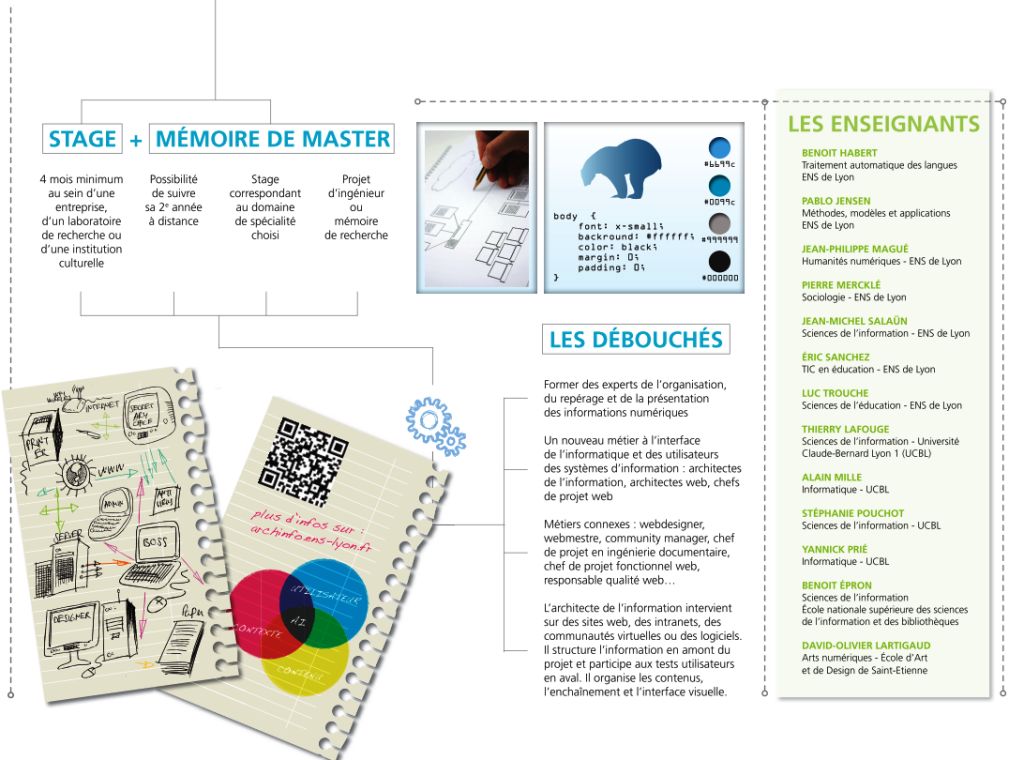
The book ends with the need for new information professionals, able to understand and make use of the changes underway to build and manage new documentary infrastructures. The iSchools in North America today train professionals skilled in both computer science and information science. These new professionals are sometimes called Information Architects. In French, I suggest using the term "archithécaires" to indicate those new skills, rooted in the knowledge of library science, but greatly exceeding it.
In summary, starting from the history of the document and its three-dimensional analysis, the book offers a different perspective on what is being discussed on the web. It shows that the invention of the web by Briton Tim Berners-Lee is taking over the systematic indexing efforts launched in the late nineteenth century, changing the document itself in its three dimensions: form, content and medium. The Web is then like any other media: it follows the model of the library and of broadcasting to meet the documentary aspirations of a society that has deeply changed. The old media themselves are expanding their vocation by becoming "memory industries" through the constantly ongoing and public digital archiving of their production. The newcomers, Apple, Google, Facebook, each favor a different dimension of the document, trying to take a dominant position in the construction of a "neodocument." (...)
Par Jean-Michel Salaun le mardi 17 janvier 2012, 16:03
Plusieurs dizaines de lecteurs sagaces de ce blogue ont repéré que j'ai commencé à en indexer les billets. Il me faut donc donner quelques explications.
L'indexation est réalisée en langage contrôlé sur la base de la table des matières du livre. Mon objectif est de relier étroitement le livre et le blogue qui l'a inspiré et alimenté et qui reste un bon instrument pour l'actualiser et le critiquer.
Mais patience ! Le livre ne sera en librairie que le 9 février et l'indexation n'est pas encore terminée...
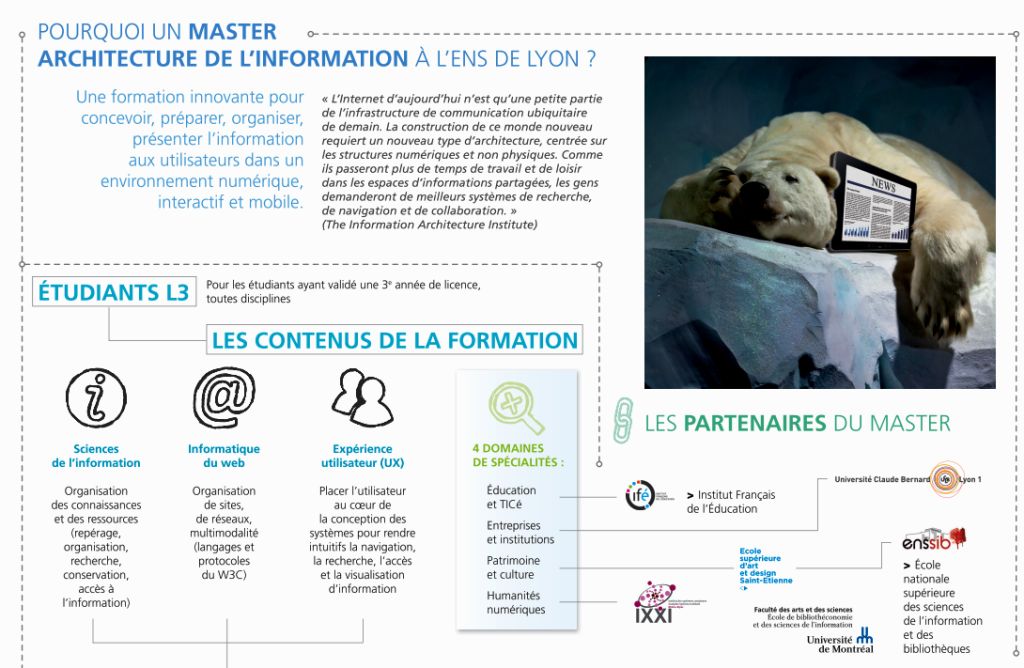
Le terme Architecte de l'information est peu usité dans la francophonie, mais cela pourrait bien changer en 2012.
Voici quelques-unes des manifestations et évènements prévus sur cette thématique en France et au Québec (j'en oublie sûrement, n'hésitez pas à compléter) :
31 janvier 2012, 9h30-17h Qu’est-ce qu’un architecte de l’information ? Journée INTD-CNAM (Dicen) / Paris 8 (Index-Paragraphe), CNAM, 292 rue St Martin, Paris 3ème, Amphi Z, Programme et inscription
11 février, World IA Day, 14h30-18h La Cantine, 151 rue Montmartre, Passage des Panoramas 12 Galerie Montmartre, 75002 Paris, Programme et inscriptions
1er mars, sortie d'un dossier documentaire sur l'architecture de l'information par le service Veille & Analyse de l'Institut Français d'éducation.
18 juin - 29 juin, cours Architecture de l'information documentaire à l'EBSI de l'Université de Montréal. Version 2011
18-20 juin, école d'été sur l'architecture de l'information, ENS de Lyon
19-20 novembre Colloque international Architecture de l'information à l'ENS de Lyon dans le cadre des entretiens Jacques Cartier